How to Pick Halal Stocks: A Value Investing Framework for Muslim Investors
Most guides will tell you which stocks are halal. This one will teach you how to decide which halal stocks are worth buying.
There's a meaningful difference between those two things — and it's where most Muslim investors get stuck.
The halal screen tells you what you're allowed to own. That's necessary, but it's not sufficient. Once you've run the screen and confirmed a stock is permissible, the real question begins: Is this business any good? Is the price fair? Should I actually put my capital into this?
These are value investing questions. And for Muslim investors, they matter more, not less — because our investable universe is smaller, we can't afford to own mediocre businesses.
After more than two decades in financial markets — including time as a proprietary trader, auditor at KPMG, and wealth manager at Standard Chartered — I've developed a framework that combines the halal screen with the value investing criteria I use on every stock I evaluate. This article explains that framework.
What the Halal Screen Actually Tells You (and What It Doesn't)
The standard halal screen filters companies on two dimensions: business activity and financial ratios.
On business activity, the screen eliminates companies whose primary revenues come from prohibited sectors: alcohol, tobacco, gambling, conventional banking, weapons manufacturing, pork products, and adult entertainment. It also flags companies whose ancillary income from haram sources exceeds 5% of total revenue — this is where many investors stop looking, and where many edge cases slip through.
On financial ratios, the AAOIFI standards screen for:
Interest-bearing debt below 33% of total assets
Accounts receivable below 45–49% of total assets
Interest income (riba income) below 5% of total revenue
Passing all of these means you have a halal stock. It doesn't mean you have a good stock.
The screen is a gate. What's behind the gate still needs to be evaluated. A company can pass every halal filter and still be:
A declining business losing competitive ground
A heavily indebted company approaching financial distress
A stock trading at 2x its intrinsic value
A business you fundamentally don't understand
For Muslim investors, this gap between "halal" and "worth buying" is where the most expensive mistakes happen.
The Value Investing Advantage for Muslim Investors
Before getting into the framework, it's worth naming something that doesn't get said often enough: the halal screen is a value investing advantage in disguise.
Value investing, at its core, is about finding quality businesses at reasonable prices and holding them patiently. The greatest value investors — Buffett, Graham, Munger — consistently avoid companies with excessive debt, companies that earn primarily from financial engineering rather than real operations, and companies whose business model involves excessive speculation.
Those are the same companies the halal screen filters out.
High debt-to-asset ratios? The halal screen caps those at 33%. Riba-based income? Filtered. Speculative business models? Gharar — uncertainty — is prohibited in Islamic finance, which means the halal framework already pushes investors toward businesses with clear, understandable economics.
This is not a coincidence. Islamic finance principles were designed to ensure that wealth is created through real economic activity, shared risk, and fair exchange. Value investing principles were derived from the same underlying logic: invest in real businesses, don't speculate, be patient.
The Muslim investor who learns to combine a proper halal screen with a value investing evaluation framework doesn't have a smaller opportunity set than conventional investors. They have a better-filtered one.
The 5-Step Framework for Picking Halal Stocks
Step 1: Run the Complete Halal Screen
Most investors check the headline sector. Fewer check the financial ratios.
The complete screen requires reviewing the company's annual report — not just an app's verdict. Apps like Zoya and Musaffa are useful starting points, but they're working from the same public data you can access directly. For significant decisions, verify the underlying ratios yourself.
Key checks that get missed:
The receivables ratio. A company with accounts receivable above 45–49% of total assets is effectively acting as a lender — which creates riba exposure. Many otherwise clean businesses fail here, particularly those that extend long credit terms to customers.
The 5% interest income threshold. Almost every large company holds some cash in interest-bearing accounts. The question is whether that income exceeds 5% of total revenue. For borderline companies, this requires checking the notes to the financial statements, not just the income statement headline.
Dividend purification. If a halal company earns any income from impermissible sources (even within the 5% threshold), the corresponding proportion of any dividend you receive requires purification — donating that fraction to charity. Calculate this before you invest so it doesn't come as a surprise.
Step 2: Assess Business Quality
Passing the halal screen tells you the business is permissible. Step 2 asks whether it's actually worth owning.
The question I always start with: If a well-funded competitor entered this market tomorrow, how quickly could they threaten this company?
If the answer is "quickly," the business has no meaningful moat. If you have to think hard and the answer comes back "they'd struggle for years, possibly never," you may be looking at a genuine competitive advantage.
Moats come in several forms:
Brand strength. Consumers pay a premium because of what the brand represents. Halal food companies, for example, often have genuine brand loyalty within Muslim communities that competitors can't easily replicate.
Switching costs. The customer would lose too much by leaving — their data, their workflows, their team's habits. Business software is a classic example: once a company is running on a platform, the cost and disruption of switching is often prohibitive.
Network effects. The product becomes more valuable as more people use it. A marketplace with 10 million users is vastly more useful than one with 100,000, even if the underlying technology is identical.
Cost advantages. The company produces the same thing cheaper than anyone else, at scale. This is durable because it usually comes from proprietary processes, scale, or geographic advantages that take years to replicate.
Regulatory barriers. Licences, patents, or certifications that competitors can't easily obtain.
Beyond the moat test, check the basics:
Has revenue grown consistently over the past 5 years? Flat or declining revenue in a growing economy is a warning sign.
Is free cash flow (operating cash flow minus capital expenditure) consistently positive? This is the actual cash the business generates — harder to manipulate than net profit.
Is Return on Equity above 15% consistently? This measures how efficiently the company uses capital. Below 10% is a warning; above 15% consistently suggests a quality business.
Does management's track record over 3–5 years suggest honest capital allocation? Read the annual reports. Tone matters. Overconfident management often precedes poor decisions.
Step 3: Check Financial Health
A good business in financial distress is still a dangerous investment.
The balance sheet tells you whether the company can survive difficulty — a market downturn, a competitive challenge, an unexpected economic shock. For Muslim investors who aim to hold for years, not months, this matters enormously.
The key ratios:
Current ratio above 1.5. Current assets ÷ current liabilities. Above 1.5 means the company can comfortably cover its short-term obligations. Below 1.0 means it technically cannot pay its immediate debts — a serious red flag.
Long-term debt-to-equity below 0.5. How much long-term debt is the company carrying relative to shareholders' equity? Below 0.5 is conservative and healthy. Above 1.0 means debt exceeds equity, which amplifies risk in both directions. Note: this check is complementary to the halal screen's debt-to-assets ratio — both matter.
No consecutive years of net losses in the past 5 years. One bad year is acceptable — markets are cyclical. Two or more consecutive years of losses signal a structural problem, not a temporary setback.
Interest coverage ratio above 5x. EBIT ÷ interest expense. Above 5x means the company comfortably services its debt from operating earnings. Below 2x is dangerous — a modest earnings decline could make debt payments difficult. This ratio also matters for halal investors specifically: a company with high interest payments is more entangled in riba, even if it passes the absolute ratio thresholds.
Step 4: Value the Stock
This is the step most investors skip. It's also the most important.
Every stock has an intrinsic value — what the business is actually worth based on its earnings, assets, and growth prospects. The market prices it higher or lower depending on sentiment, news cycles, and investor emotion. Your job is to find the gap between what something is worth and what you're paying for it.
Start with a simple intrinsic value estimate. For a stable, profitable business, a reasonable starting point is:
Intrinsic value ≈ Earnings Per Share (EPS) × a reasonable P/E multiple
For a company earning $2.50 per share in a stable industry, a reasonable P/E might be 15x. That gives an intrinsic value estimate of $37.50. If the stock is trading at $28, you have roughly a 25% discount to estimated fair value.
This is a rough calculation, not a precise one. The goal isn't accuracy to the penny — it's to know whether you're buying something well below, at, or above fair value.
Apply a margin of safety. Benjamin Graham introduced this concept in 1949, and it's as relevant now as it was then. The margin of safety is the gap between intrinsic value and purchase price. Aim for 20–30% below your estimated intrinsic value.
The margin of safety serves two purposes. It protects you if your estimate is wrong — and it will be, sometimes. And it gives the investment room to generate returns even if the business performs below your expectations.
For Muslim investors managing a reduced universe of halal stocks, the margin of safety is especially important. You can't diversify your way out of paying too much for everything — eventually it catches up with you.
Compare the current P/E to the stock's 5-year average P/E. If the market has historically valued this business at 20x earnings and it's currently trading at 12x, the market may have oversold it. Historical P/E context doesn't replace a fundamental valuation, but it provides useful reference. (A low P/E can also be a value trap — the business quality checks in Step 2 are what tell you which one you're looking at.)
Consider dividend sustainability if applicable. If the company pays dividends, check the payout ratio: dividends ÷ earnings. A ratio below 60% is generally sustainable. Above 80% risks a dividend cut if earnings dip. And remember: if you receive dividends from a company that has any impermissible income (within the 5% threshold), calculate the purification amount before you collect.
Step 5: The Barakah Check
This is the check no conventional course includes, and the one that matters most in the long run.
Do you understand this business well enough to explain it simply? If you cannot explain in two sentences what this company does and how it earns its money, you don't understand it well enough to own it. This isn't a harsh standard — it's a useful one. Warren Buffett calls it the circle of competence. It also maps to Islamic principles around gharar (uncertainty): you shouldn't invest in something whose nature and risks you cannot grasp.
Would you be comfortable holding this for 5+ years? If the thought of not being able to check the share price for a year makes you anxious, reconsider whether this is the right investment or the right mindset. Barakah-aligned investing is patient investing. The compounding that creates meaningful wealth happens over years and decades, not months.
Does this business create genuine value? Beyond passing the screen, ask whether this company contributes positively to the world. Does it serve its customers fairly? Does it treat employees with dignity? A business that passes all screens but operates exploitatively is still something to think carefully about — the screen is necessary, not sufficient, for alignment with Islamic values.
Is your niyyah right? Why are you investing? To build wealth for your family, to fulfil your financial obligations, to give more in sadaqah? Or are you chasing excitement and quick returns? Your intention shapes your relationship with the outcome. The Prophet ﷺ said: "Actions are judged by intentions." This applies to financial decisions too.
Putting It Together: A Practical Example
To illustrate how the framework works in practice, consider a hypothetical manufacturer of consumer healthcare products — a business that:
Earns no revenue from prohibited sectors
Has riba income below 1% of total revenue
Carries interest-bearing debt at 18% of total assets
Has a consistent 5-year revenue growth of 8% per year
Generates positive free cash flow in every year of the past decade
Has a Return on Equity averaging 18%
Trades at a P/E of 14x against a 5-year average of 19x
Has a current ratio of 1.8 and debt-to-equity of 0.35
Running the framework:
Step 1 (Halal screen): Pass on all counts
Step 2 (Business quality): Strong recurring revenue, moat from brand and distribution, consistent cash generation. Pass.
Step 3 (Financial health): Conservative balance sheet, healthy coverage ratios. Pass.
Step 4 (Valuation): Trading at 14x vs 5-year average of 19x suggests potential undervaluation. If EPS is $3.00 and fair P/E is 17x, intrinsic value estimate is approximately $51. Current price at 14x would be around $42 — roughly an 18% discount. Marginal, but positive.
Step 5 (Barakah check): Business is simple to understand, creates real value, nothing uncomfortable about the business model.
This is the kind of analysis that turns a screen result into an investment decision.
The Most Common Mistakes Muslim Investors Make
Stopping at the screen. The screen is the beginning of the process, not the end.
Buying without understanding the business. Gharar isn't just about the contract structure — investing in something you fundamentally don't understand carries its own uncertainty. Understand what you own.
Ignoring valuation. You can buy a great halal business and lose significant money if you pay too much. Margin of safety is not optional.
Confusing short-term price movements with investment performance. A stock that falls 15% after you buy it hasn't proven your analysis wrong. A business that deteriorates fundamentally has. Know the difference.
Not purifying income. Purification is an obligation, not optional. If a halal company earns any impermissible income (within the 5% screen), you are responsible for donating the corresponding proportion of your dividend or return. Build this into your process.
Frequently Asked Questions
Is value investing compatible with halal investing?
Value investing is not just compatible with halal investing — the two methodologies share fundamental principles. Value investing emphasises patience, understanding the underlying business, avoiding excessive debt, and paying a fair price. Islamic finance principles emphasise the same things through different language: long-term stewardship of wealth, avoiding gharar, prohibiting riba, and ensuring wealth is created through real economic activity. The Amana Funds, one of the oldest and most established halal investment vehicles in the US, uses a value-oriented approach. The compatibility is not coincidental.
Can I use stock screening apps as my only evaluation tool?
Apps like Zoya and Musaffa are genuinely useful for a first-pass screen — they cover thousands of stocks and save significant time. But they should be starting points, not endpoints. They don't evaluate business quality, assess management, or tell you whether you're paying a fair price. For any meaningful investment, verify the underlying ratios directly from the annual report and run the business quality and valuation analysis yourself.
What's a reasonable number of halal stocks to hold in a portfolio?
Most professional investors hold concentrated portfolios — 10 to 20 positions. Diversifying across 50+ stocks in a reduced halal universe often means owning mediocre businesses at indifferent prices. Better to know 12 businesses deeply and own them at a margin of safety than to own 40 businesses you barely understand. That said, concentration requires conviction, and conviction requires the kind of analysis this article describes.
How often should I re-screen existing holdings for halal compliance?
Shariah compliance isn't static. Companies take on debt, change business lines, make acquisitions. A stock that was halal when you bought it may no longer be. Review your holdings at minimum annually, or when the company reports significant corporate changes. Many screening apps offer automated alerts when compliance status changes — these are worth enabling.
Does investing in halal ETFs remove the need for individual stock analysis?
Halal ETFs like SPUS and HLAL handle the screening automatically and provide instant diversification. For many investors — particularly those early in their investment journey or those who don't want to spend time on individual analysis — they're an excellent option. The trade-off is that ETF investors pay an expense ratio, give up some control over what they own, and receive the market's average return within the halal universe rather than the potential outperformance available from careful individual stock selection. Neither approach is universally superior — the right choice depends on your time, knowledge, and goals.
Nothing in this article constitutes financial advice. This is educational material intended to help Muslim investors think more clearly about stock selection. Always conduct your own research and consult qualified professionals before making investment decisions.
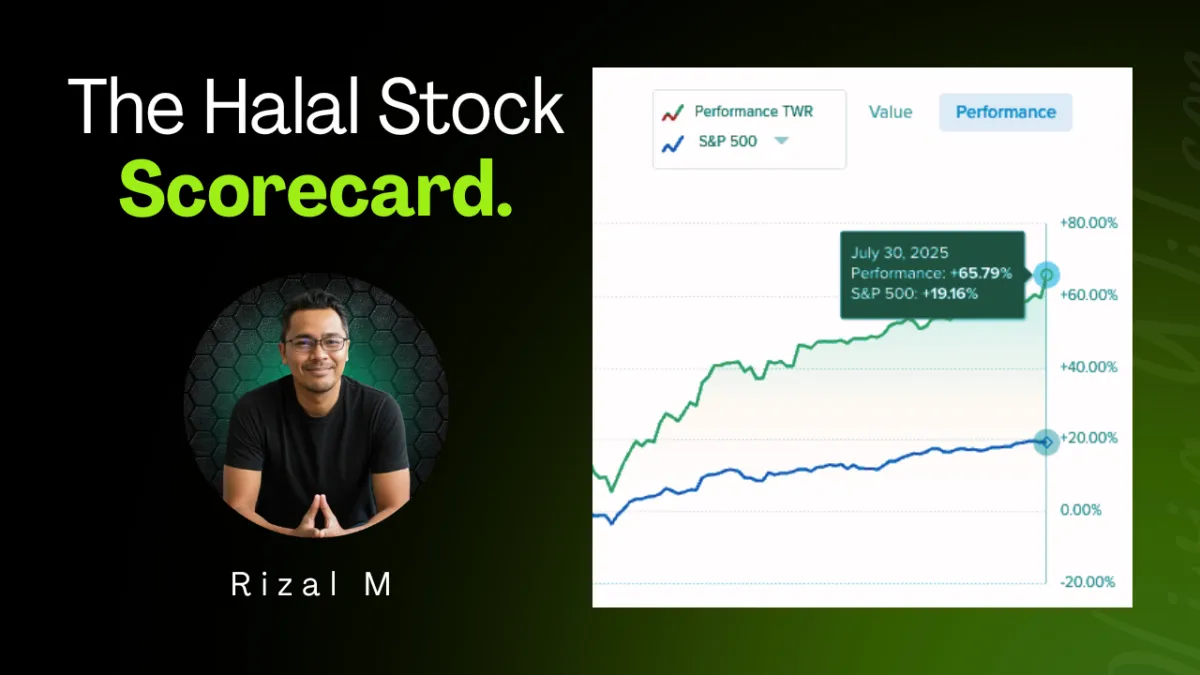
For a practical tool to apply this framework, download the free Halal Stock Scorecard at barakahprofits.com/scorecard — a 21-check PDF that walks through every step.


